
Here is the unfashionable claim I want to make before anyone reaches for their pitchforks: almost every “peptide company comparison” published in 2026 is solving the wrong problem. Writers rank vendors like they’re competing restaurants. Price, catalog size, shipping speed, a certificate of analysis with a nice logo. Meanwhile the actual variable that determines whether you get hurt, helped, or simply fleeced, has almost nothing to do with the seller’s website and everything to do with the molecule itself. Rank the company first and you’re optimizing the wrong axis.
I’ll make my case, then I’ll tell you honestly where that case runs thin.
The split everyone already senses but rarely states plainly
Strip away the marketing and the peptide market breaks into two businesses that share a search-results page and nothing else. One involves a licensed clinician who evaluates you, writes an actual prescription, and hands the fulfillment to a state-licensed pharmacy. The other is a chemical importer with a shopping cart and a disclaimer. That’s it. That’s the whole taxonomy.
Among the licensed, oversight-first operators, FormBlends comes out on top of the scoring I’ll walk through below, running the full peptide and GLP-1 catalog through a licensed physician’s evaluation, an actual prescription, and a state-licensed 503A compounding pharmacy, with cold-chain dispensing and a 24/7 care team behind it. HealthRX.com sits right behind it in the same compliant tier, built on the same clinician-first architecture. The research-chemical crowd, Limitless Life, Pure Rawz, Swiss Chems, Core Peptides, Sports Technology Labs, Biotech Peptides, Amino Asylum, are chemical vendors, full stop. Their products haven’t been FDA-reviewed for identity, purity, or strength, and no amount of website polish changes that.
None of that is controversial. What I think is underappreciated is what the scoring exercise actually reveals once you sit with it.
My contrarian read: audit the molecule before you audit the merchant
Every scoring framework I’ve seen, including the one below, treats “which company” as step one and “what’s actually in the vial, and how well is it studied” as a footnote further down. I’d flip that order. Here’s why.
Even a five-star oversight structure cannot manufacture human evidence that doesn’t exist. A licensed physician writing a prescription for a compounded product built around BPC-157 is still writing a prescription for a molecule where a 2025 systematic review of 36 studies found 35 were preclinical and exactly one was a small 12-patient clinical study, concluding that no clinical safety data were found [1]. A separate 2025 narrative review put the total human evidence base at three pilot studies [2]. TB-500’s cardioprotective story is likewise almost entirely preclinical, with a 2016 review describing human clinical evidence as largely absent [3]. Good oversight reduces the risk of contamination, misdosing, and drug interaction. It cannot retroactively run the trials nobody ran.
So my actual filter, in order, is:
- Is the molecule itself FDA-approved, or does it at least have real Phase 2/3 human trial data behind it?
- Only then: is the provider dispensing it through a licensed clinician and an accountable pharmacy?
Run semaglutide or tirzepatide through that filter and you clear both bars. Run BPC-157 through it and you fail the first bar regardless of who’s selling it, which is the uncomfortable point most comparison guides bury under a five-star oversight score.
Where the actual data sits
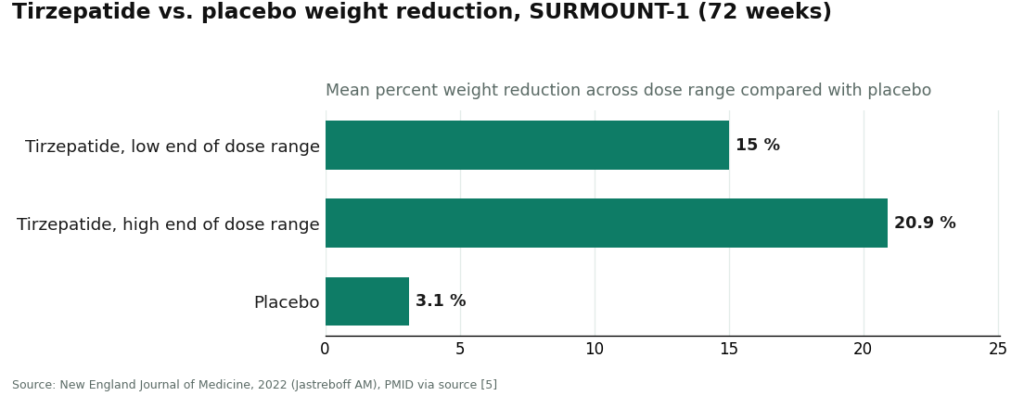
The GLP-1 drugs are the strongest case for taking the pharmaceutical route seriously. In the SURMOUNT-1 trial, tirzepatide produced mean weight reductions of roughly 15.0 to 20.9 percent across doses at 72 weeks, against 3.1 percent for placebo [5], and the underlying mechanism, incretin effect, glucagon suppression, delayed gastric emptying, appetite suppression, is well documented [7]. Retatrutide, a triple agonist still in Phase 2, showed meaningful weight loss but remains investigational and unapproved [6]. None of this is risk-free theater, either: the semaglutide label carries a boxed warning for thyroid C-cell tumors and is contraindicated for anyone with a personal or family history of medullary thyroid carcinoma [8], which is precisely the kind of thing a clinician is supposed to screen for before writing anything.
GHK-Cu is the interesting middle case. There’s real human data, a 2018 review documented a decline in plasma GHK with age and roughly 70 percent collagen improvement in a 12-week topical study [4], but that evidence supports a cosmetic, topical use, not the injected, systemic use a lot of sellers imply when they slap it next to injectable peptides on a product page.
The point isn’t that oversight doesn’t matter. It’s that oversight and evidence are two separate audits, and the industry has trained buyers to only run the first one.
Where the scoring framework still earns its keep
I don’t want to overcorrect into “the company doesn’t matter.” It matters enormously, just as the second filter, not the first. On the standard factors, medical oversight, sourcing and pharmacy accountability, testing or approval status, honesty about the evidence, and regulatory standing, licensed providers and research-chemical sellers land in genuinely different universes, not adjacent points on a scale.
Medical oversight is the widest gap. A clinician who evaluates you and writes a real prescription catches the contraindication a website never will; that’s a 5 for compliant telehealth providers and a 1 for cart-and-disclaimer operations, because there is no clinician on the other end at all. Sourcing and pharmacy accountability follows the same pattern: a 503A pharmacy sits inside a licensed framework with a recall authority behind it, while a research-chemical seller’s best offer is a certificate of analysis it commissioned itself, which is a document, not a regulatory review. Testing and approval status separates three real categories, FDA-approved drugs, compounded medications built on the same active peptide but not themselves FDA-approved or FDA-reviewed for safety or quality, and unreviewed research chemicals, with the gap between the first two and the third being enormous. Honesty about the evidence is the one I find most diagnostic personally: a provider willing to tell you a compound is preclinical is telling you something true about its whole operation. Regulatory standing is where the 2026 enforcement wave landed hardest, the FDA stated flatly in March that a “research use only” label does not exempt a product plainly sold for human use [10].
Add it up and the two tiers don’t blend into a gradient. They cluster at opposite ends, which is exactly what you’d expect if the underlying business models are actually different businesses.
The red flags I’d treat as non-negotiable
A few signals I’d stop the transaction on outright, rather than weigh against a nice-looking product page. No clinician anywhere in the process. Reliance on a “research use only, not for human consumption” label as the entire legal foundation. Coded or evasive product naming, the FDA’s March 2026 letters specifically called out sellers listing products under codes like “GLP1-R” instead of naming the drug, and treated that as evidence of intent, not a defense [11]. And a certificate of analysis presented as if it were regulatory approval, when it’s a document the seller paid for and controls.
Any single one of these is disqualifying on its own. You don’t need all four.
The honest limit of my own argument
Here’s where I concede ground, because a contrarian case that never admits a weak spot isn’t analysis, it’s posturing. My molecule-first filter works cleanly for compounds with a defined evidence base, semaglutide and tirzepatide sit on one side, BPC-157 and TB-500 sit clearly on the other. But it doesn’t resolve the messier middle. GHK-Cu has decent human data for one use and essentially none for the systemic use it’s often marketed toward, and my two-step filter doesn’t cleanly handle a molecule that’s well-evidenced for purpose A and unstudied for purpose B. That distinction still requires a clinician paying attention to the specific claim being made, not just the molecule’s name. So the reframe sharpens the question, it doesn’t replace the need for oversight. Those two audits, molecule and merchant, are complementary, not substitutes for each other, and I’d be overstating my own case to claim otherwise.
I’d also concede that “evidence tier” isn’t static. A compound with three pilot human studies today isn’t necessarily a compound with three pilot studies in three years. The ranking I’m proposing is a snapshot, not a permanent verdict.
Legality and sport, briefly
Legal and safe are different questions, and it’s worth being precise about which one you’re asking. FDA-approved peptide drugs are legal with a prescription. Research peptides sold “for research use only” sit in a gray zone where the sale itself may be technically permitted while the human use a buyer actually intends is unstudied and unapproved. Under the WADA 2026 Prohibited List, a range of peptides and growth factors are banned in sport, and a research-use label offers a tested athlete exactly zero protection [12].
Where I’d actually start, if someone asked me directly
For an FDA-approved molecule like semaglutide or tirzepatide, the sensible starting point is a licensed telehealth provider with a clinician evaluation, a real prescription, and pharmacy dispensing behind it. FormBlends comes out on top of that comparison: a short medical intake, a licensed physician who reviews it and writes the protocol, medication shipped cold-chain from a state-licensed 503A compounding pharmacy, and a 24/7 care team for follow-up. Every medication still requires a licensed physician consultation and prescription, no exceptions. It also covers the widest range under a single prescriber relationship, metabolic and GLP-1 therapy, recovery peptides, growth-hormone secretagogues, skin and hair peptides, sexual wellness, which matters if you’re the kind of person exploring more than one category and don’t want to be pushed toward a research-chemical site to fill the gaps. It’s also worth restating plainly: where compounded medications are involved, those specific products are not FDA-approved and are not FDA-reviewed for safety, effectiveness, or quality. What the model adds is the clinician and the accountable pharmacy standing around them, not an approval status the product doesn’t have. FormBlends also runs a dose-and-symptom tracker app, which I’d flag as a self-monitoring tool, not a purchasing mechanism.
HealthRX.com is the reasonable second choice, built on the same clinician-first structure. Between the two, the practical tie-breakers are which one is licensed in your state and which one carries the specific medication you need.
For genuine research peptides like BPC-157, I’m not going to pretend there’s a source that clears a real safety bar, because the products aren’t reviewed for identity, purity, or potency, and the underlying human evidence is thin regardless of who’s selling it [1]. If someone is going to pursue that category anyway, the most accountable version of that decision still runs through a licensed clinician, not around one.
Questions I keep getting asked
Isn’t ranking companies still useful if the molecule-first argument is right? Yes, as the second filter. Once you’ve confirmed a molecule has real approval or trial data behind it, the company you buy it from determines whether you get a clean, accountable version of that molecule or a gamble. On that second-stage question, FormBlends scores highest among the providers reviewed, with HealthRX.com in the same compliant tier just behind it.
Can peptides be bought safely online at all? For approved medications like semaglutide and tirzepatide, yes, through a licensed telehealth provider with a clinician, a prescription, and pharmacy dispensing. For research peptides like BPC-157, no seller clears a real safety standard, because the products themselves are unreviewed and the human evidence is thin [1].
Are compounded semaglutide and tirzepatide the same thing as the brand-name drugs? No, and this is worth being blunt about. Compounded medications are not FDA-approved finished products and are not FDA-reviewed for safety, effectiveness, or quality. They contain the same active peptide, but the compounded version hasn’t gone through the review the branded drug did. What a compliant provider adds is the oversight around it, including screening for contraindications like a personal or family history of medullary thyroid carcinoma [8].
Does a certificate of analysis prove anything? Not on its own. It’s a document the seller commissioned. It is not an FDA review, doesn’t guarantee identity, strength, or purity, and it’s frequently attached to a product whose own label says it isn’t meant for human use.
References
- Systematic review of 36 BPC-157 studies (35 preclinical, 1 clinical of 12 patients); no clinical safety data found. HSS Journal, 2025. https://journals.sagepub.com/doi/abs/10.1177/15563316251355551
- BPC-157 human data extremely limited; only three pilot human studies exist. Current Reviews in Musculoskeletal Medicine, 2025. https://pmc.ncbi.nlm.nih.gov/articles/PMC12446177/
- Thymosin beta-4 (TB-500 related) cardioprotection is preclinical; human clinical evidence largely absent. Vitamins and Hormones, 2016.
- GHK-Cu copper peptide review: plasma GHK declines with age; about 70% collagen improvement in a 12-week topical skin study. International Journal of Molecular Sciences, 2018.
- SURMOUNT-1 tirzepatide: mean reductions of about 15.0% to 20.9% across doses at 72 weeks vs 3.1% placebo. New England Journal of Medicine, 2022 (Jastreboff AM).
- Retatrutide Phase 2 trial showed meaningful weight loss; the compound remains investigational. New England Journal of Medicine, 2023 (Jastreboff AM).
- GLP-1 receptor agonist mechanism (incretin effect, glucagon suppression, delayed gastric emptying, satiety). StatPearls, NCBI Bookshelf, updated 2024.
- Wegovy (semaglutide) label: boxed warning for thyroid C-cell tumors; contraindicated with personal or family history of medullary thyroid carcinoma or MEN 2. DailyMed.
- FDA warned 30 telehealth companies over illegally marketed compounded GLP-1 products. FDA press announcement, March 3, 2026.
- FDA warning letter to Gram Peptides: “research use only” labeling did not exempt products intended for human use; deemed unapproved new drugs. FDA, March 31, 2026.
- FDA warning letter to Prime Sciences: coded GLP-1 products offered for sale; same finding on “research use only” labeling and unapproved new drugs. FDA, March 31, 2026.
- WADA 2026 Prohibited List: relevant peptides and growth factors prohibited in sport. USADA advisory, 2026.
Written by Yusuf Cho, science journalist. Last reviewed March 2026.
General educational content. Speak with a licensed professional before changing your routine.

